DOW-UAP-PR099, "Hi-Res: [CALLSIGN] Observes UAP on 25SEP19 at 1715Z"
Investigation reading
This Release 02 item is an official Department of War / AARO video record from manifest row 159, published in the 5/22/26 WAR.GOV/PURSUE release and mirrored through DVIDS video ID 1007738. The title is preserved as source/catalog language: "Hi-Res: [CALLSIGN] Observes UAP on 25SEP19 at 1715Z". This page does not treat the title's UAP, date, time, callsign, or observes wording as an Open Sky finding about object identity, sensor lock, event timing, or significance.
The official release description says eight U.S. House members requested access to 51 potentially UAP-related records allegedly held by the Department of War and the Intelligence Community. AARO identified responsive materials held on a classified network and warns that many of these materials lack a substantiated chain of custody. For this row, AARO assesses that the video is likely derived from an infrared sensor aboard a U.S. military platform operating within the United States Central Command area of responsibility in 2019. It also says a user uploaded the video to a classified network in November 2019.
There is a visible source-date/title tension to preserve. The manifest title and DVIDS title use 25SEP19 at 1715Z; the description body says the uploader-defined title was Hi-Res: [CALLSIGN] Observes UAPs on 23SEP19 at 1715Z; DVIDS lists date taken 09.23.2019; the VIRIN begins 190924; and the manifest incident-date field supplied to this worker is 2023. Those fields should be reconciled before the item is used for timeline or location analysis.
The source-provided video duration is 00:04:51. The official description breaks the public clip into these windows: 00:00 to 00:44, No Content; 00:45 to 00:46, an area of contrast enters the field of view from the left and exits the lower-left corner; 00:47 to 01:07, No Content; 01:08 to 01:25, an area of contrast appears from the left while the sensor pans to hold it near the center of the field of view; 01:26 to 01:45, the sensor changes visual settings and continues tracking the area of contrast; 01:46 to 01:47, another area of contrast enters from the bottom of the frame; 01:47 to 01:55, the screen flashes black before the sensor continues tracking areas of contrast, with multiple areas entering and exiting the field of view; and 04:00 to 04:51, the screen flashes black before continuing to track an area of contrast. The source text explicitly says this description is informational only and should not be interpreted as an analytical judgment, investigative conclusion, or factual determination about the event's validity, nature, or significance.
The DVIDS page resolves to https://www.dvidshub.net/video/1007738/dow-uap-pr099-hi-res-callsign-observes-uap-25sep19-1715z. It lists date taken 09.23.2019, date posted 05.22.2026 07:30, category B-Roll, video ID 1007738, VIRIN 190924-D-D0360-3362, filename DOD_111719835, length 00:04:51, and location (UNDISCLOSED LOCATION). The manifest gives incident location CENTCOM, while DVIDS gives only (UNDISCLOSED LOCATION); neither field supplies coordinates, platform position, line of sight, range, altitude, or original sensor metadata.
What the released item appears to contain
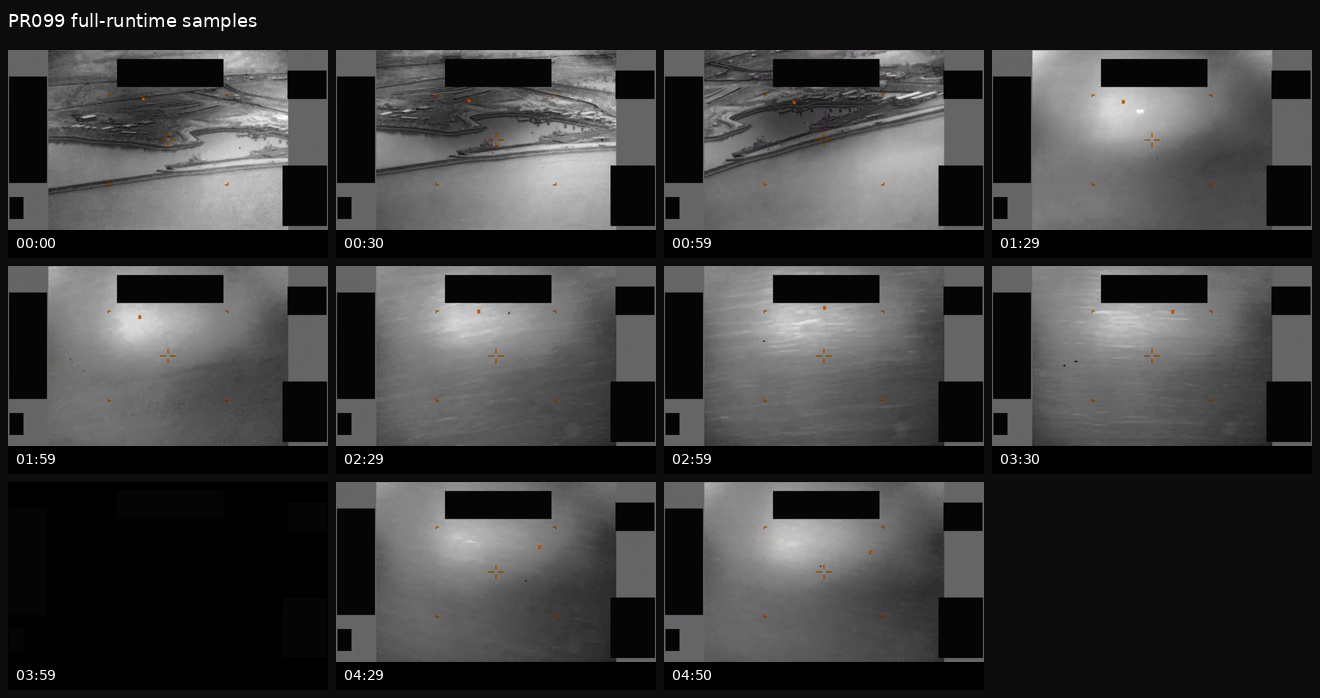
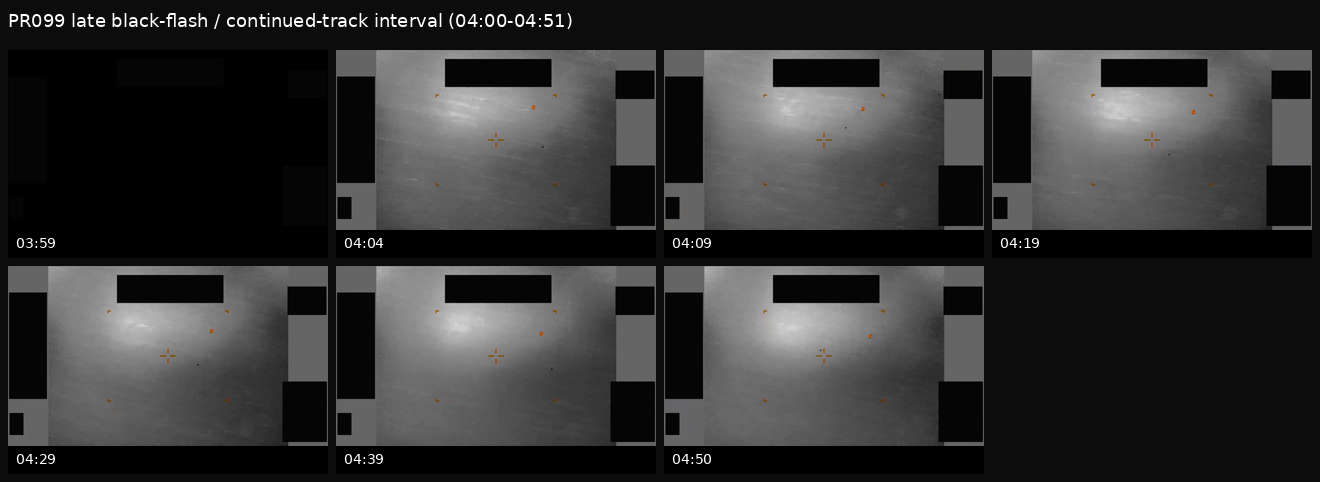
The downloaded direct MP4 is a 1280×720 sensor-display clip with mostly monochrome/infrared-style scene content, an orange central reticle or crosshair, small orange marker/tick overlays, large black rectangular masks around the top and sides, and gray side/border panels. The masks, reticle, timestamps in the derived stills, and orange markers are display or review features, not scene content.
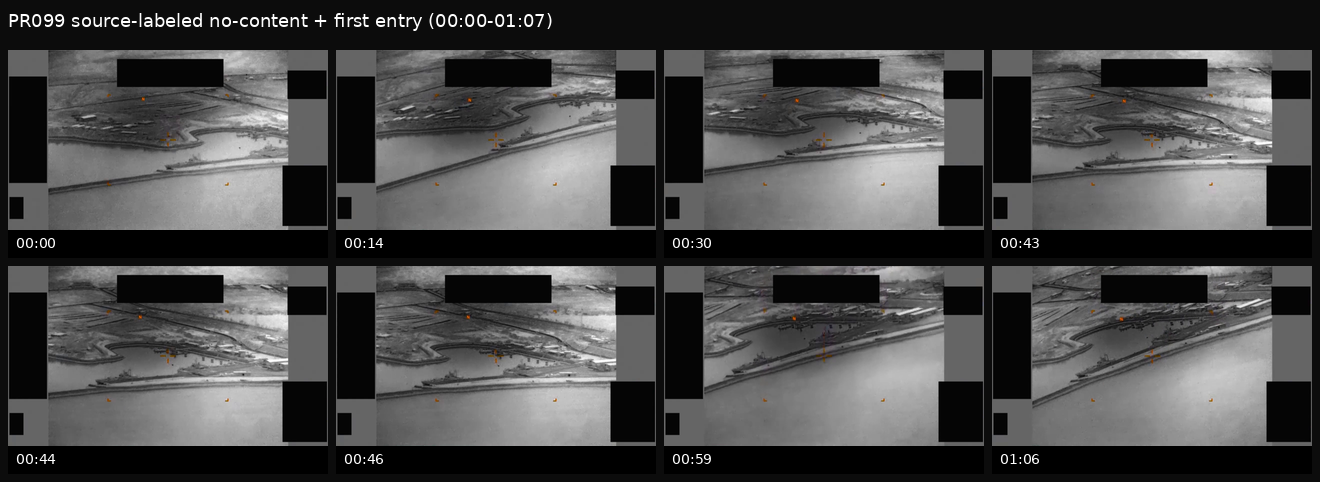
The source-labeled 00:00 to 00:44 No Content interval is not literally blank in the public MP4. Sampled frames show an oblique waterfront or shoreline scene with water, land/shoreline boundaries, linear infrastructure, and at least one vessel-like silhouette or harbor feature in the early view. This visible context does not by itself identify the source platform, exact geography, or any UAP-related feature.
The source-described 00:45 to 00:46 first-entry window is very short. The sampled stills around 00:44 and 00:46 preserve the sensor-display context and waterfront scene but do not resolve a target identity from the stills alone. That window needs continuous full-resolution playback before any claim is made about entry path, speed, or continuity.
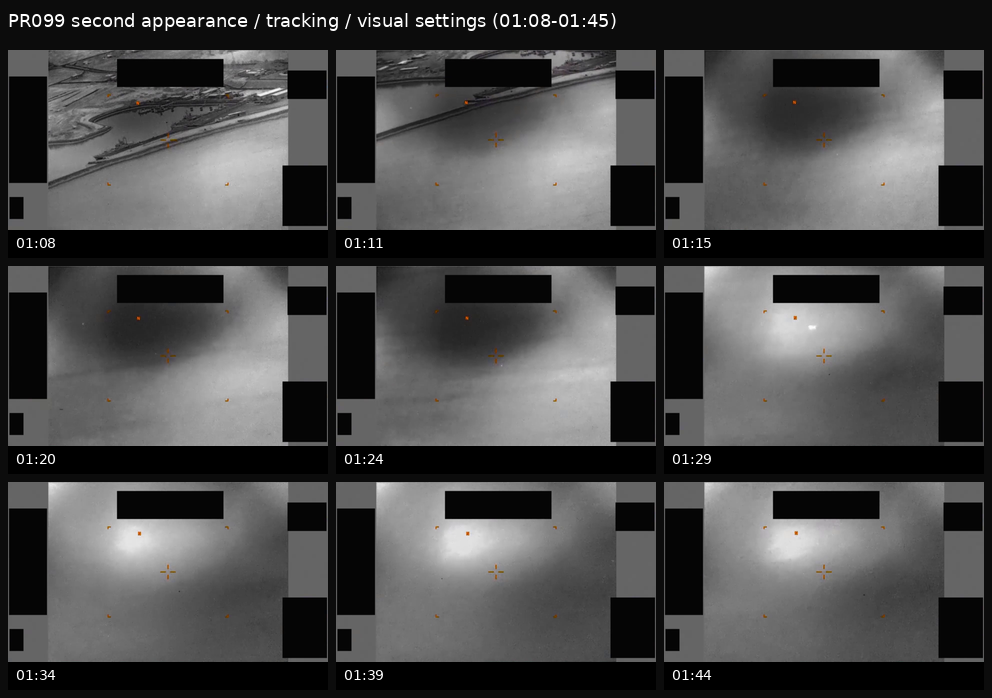
In the 01:08 to 01:45 window, sampled frames show the view transition from more recognizable shoreline/water structure into a smoother low-contrast gray field with a broad diffuse bright region and small localized specks or contrast points. A tiny bright or dark localized contrast feature is most noticeable in some later samples around 01:29 to 01:44, but it remains unresolved and partly entangled with background texture, sensor/display overlays, contrast changes, and compression. The stills support only cautious area of contrast language, not object identity, shape, size, distance, altitude, or anomalous performance.
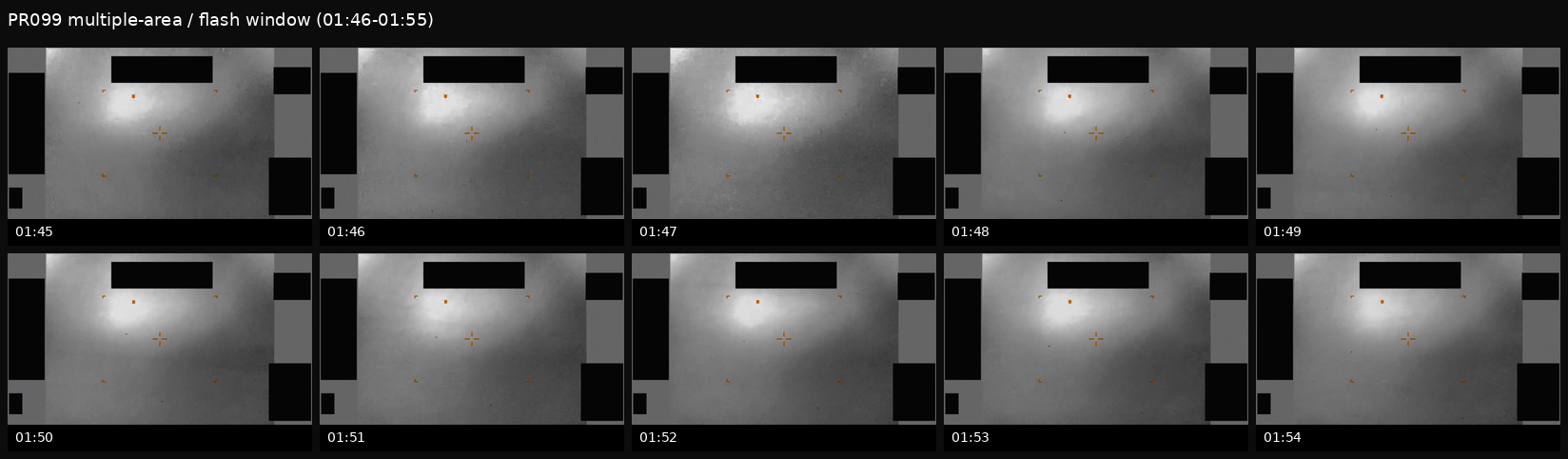
The 01:46 to 01:55 source-described multiple-area / flash window is sampled here at one-second intervals from roughly 01:45 through 01:54. Those stills show the same masked sensor display, diffuse bright region, mottled gray field, orange overlays, and tiny specks or contrast areas. They do not show a full-frame black flash in the sampled seconds; a momentary flash could fall between samples, and continuous playback remains the better review path. The small specks in the stills are too faint to identify or count as separate objects from this public MP4 alone.
Near the late 04:00 to 04:51 window, the derived sheet captures a near-black frame at about 03:59, followed by restored grayscale imagery from 04:04 onward. After the dark frame, the reticle and sensor display remain visible, and a faint point-like contrast feature appears intermittently near the central reticle area. This is consistent with the source description that the screen flashes black before continued tracking, but it does not prove uninterrupted target lock or establish that every later speck is the same physical feature.
The MP4 includes an AAC stereo audio stream, but the full decoded audio check returned zero signal: RMS 0.0, mean absolute sample 0.0, max absolute sample 0.0, and zero nonzero sample values across 27,970,432 sample values. No transcript or audible content is quoted here. The contact sheets below are derived review aids from the downloaded official MP4; they are not independent evidence and should not be used to infer cause, identity, number of objects, speed, range, altitude, platform, or event significance.
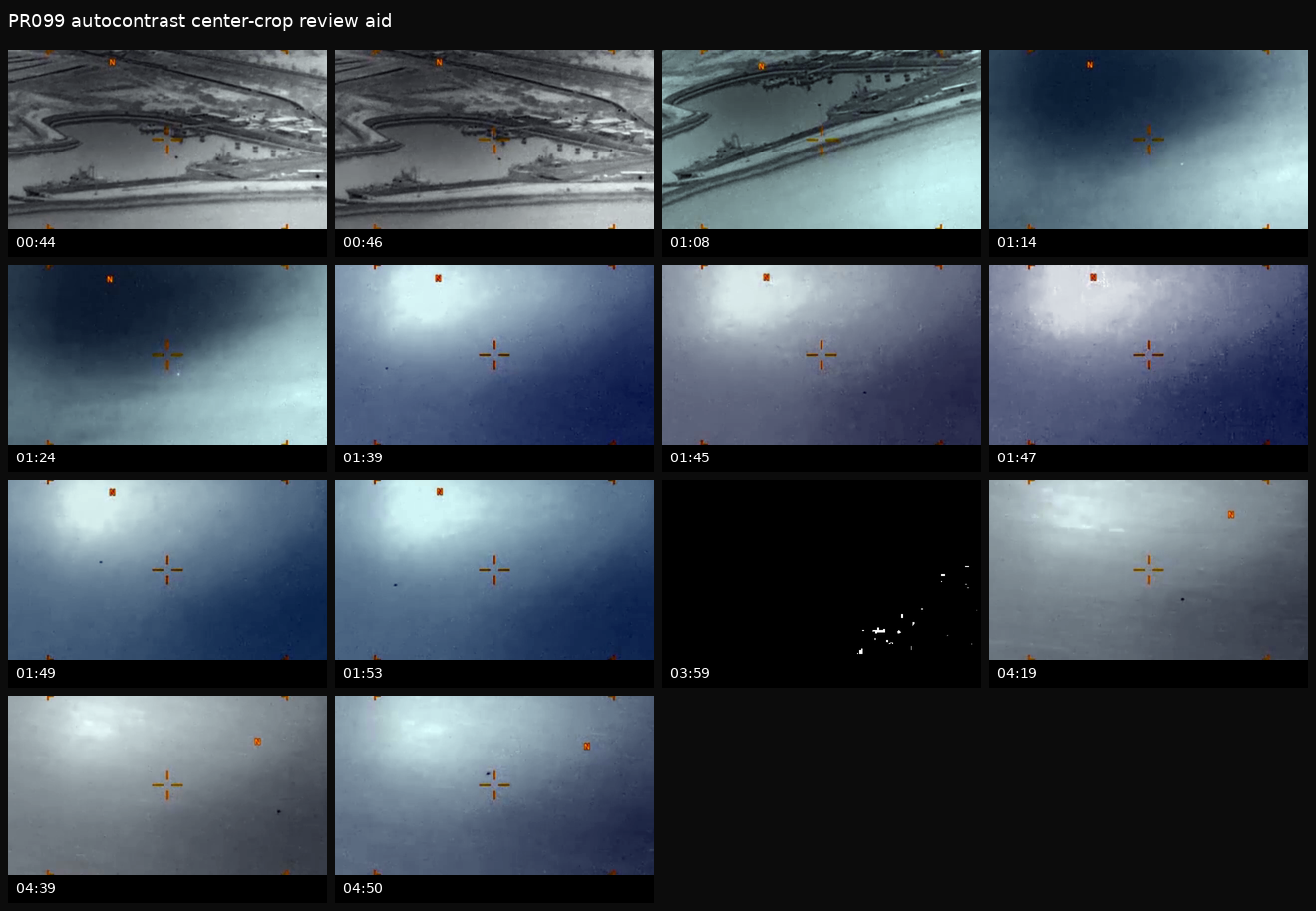
The final autocontrast sheet is intentionally labeled as a review aid. It makes shoreline structure, diffuse bright patches, faint specks, sensor noise, compression artifacts, and overlay-adjacent edges easier to see, but it also exaggerates them. Brightness, apparent shape, and apparent size in that sheet should not be compared across panels or used for photometry, measurement, or object identification without checking the original, unenhanced video.
Source asset review
The individual official DVIDS/CloudFront MP4 was downloaded and inspected directly; the full Release 02 video ZIP was not used as a substitute. The direct media response returned 200, content-type: binary/octet-stream, accept-ranges: bytes, content-length: 80316993, last-modified: Fri, 22 May 2026 11:30:55 GMT, and ETag "9578bde8bdb10d832671d2bea462cc81-10". A byte-range probe returned 206 with content-range: bytes 0-15/80316993; the first 16 bytes were MP4/M4V header bytes 0000001c667479704d34562000000001.
| Field | Source-review value |
|---|---|
| Direct media URL | https://d34w7g4gy10iej.cloudfront.net/video/2605/DOD_111719835/DOD_111719835.mp4 |
| Downloaded size | 80,316,993 bytes |
| SHA-256 | b885581a342cf9c00b7ecb541f0f9bd98c8e6cabb54f0dba45f674746ca15809 |
| CRC32 of downloaded direct MP4 | e1dc2c43 |
| Container | QuickTime / MOV (mov,mp4,m4a,3gp,3g2,mj2) |
| Duration | 291.4 seconds (00:04:51.4; manifest and DVIDS list 00:04:51) |
| Bit rate | 2,204,996 bps |
| Video stream | H.264, 1280x720, 30 fps, 8,742 frames, yuv420p |
| Audio stream | AAC stereo, 48,000 Hz, about 291.358667 seconds, 13,659 stream frames |
| Audio signal check | 13,658 decoded audio frames / 27,970,432 sample values; RMS 0.0, mean absolute sample 0.0, max absolute sample 0.0, nonzero sample values 0; audio stream present but effectively silent in this decode |
| DVIDS filename / VIRIN | DOD_111719835 / 190924-D-D0360-3362 |
| DVIDS listed length | 00:04:51 |
The Release 02 remote video-ZIP central directory lists video_2605_DOD_111719835_DOD_111719835.mp4 as 80,311,198 bytes with CRC32 cdcea1cb, stored uncompressed. Those ZIP-entry values do not match the downloaded direct DVIDS MP4 size (80,316,993 bytes) or CRC32 (e1dc2c43); the direct file is 5,795 bytes larger than the ZIP entry. This is a source-custody/versioning lead, not evidence of tampering by itself. The public page should preserve both delivery-path facts until the direct DVIDS file and Release 02 ZIP copy can be compared byte-for-byte.
Source custody and provenance
Primary public provenance for this page is the official WAR.GOV/PURSUE Release 02 landing page, the Release 02 manifest row, and the DVIDS page for video 1007738. The public DVIDS page resolves to https://www.dvidshub.net/video/1007738/dow-uap-pr099-hi-res-callsign-observes-uap-25sep19-1715z and exposes the direct media asset at https://d34w7g4gy10iej.cloudfront.net/video/2605/DOD_111719835/DOD_111719835.mp4.
The custody posture is intentionally bounded. The public release says many responsive materials lack a substantiated chain of custody. This row says the public video is likely derived from an infrared sensor aboard a U.S. military platform operating within the CENTCOM area of responsibility in 2019 and was uploaded to a classified network in November 2019. DVIDS adds date taken 09.23.2019, location (UNDISCLOSED LOCATION), VIRIN 190924-D-D0360-3362, and filename DOD_111719835. Those fields are useful public catalog facts, but they do not provide original sensor metadata, platform identity, coordinates, range, altitude, field of view, precise event time, or continuous chain-of-custody documentation. This page preserves the official manifest/DVIDS provenance and downloaded-source inspection facts without converting the uploader-defined title or visible contrast areas into an Open Sky finding.
Graph context
No exact Release 02 graph record was returned for this slug, title, or DVIDS ID during this run's read-only graph context check. That is not a source-access problem; it means this page is currently anchored to official manifest/DVIDS provenance while graph ingest for Release 02 catches up. Future title-related or dataset-wide graph hits should be treated as leads until their provenance links resolve back to this exact official asset.
Leads to check
- Reconcile the direct DVIDS MP4 (
80,316,993bytes, CRC32e1dc2c43) against the Release 02 video-ZIP entry (80,311,198bytes, CRC32cdcea1cb) before treating the two public delivery paths as byte-identical. - Reconcile the manifest/DVIDS title date
25SEP19, the description-body uploader-defined date23SEP19, DVIDS date taken09.23.2019, the190924VIRIN prefix, the manifest incident-date field2023, and the official statement that the video was uploaded to a classified network in November 2019. - Review the
00:45to00:46first-entry window in continuous full-resolution playback; the sampled stills are too sparse to support speed, path, or target-continuity claims. - Review the
01:08to01:55tracking / visual-settings / multiple-area windows against the unenhanced video before counting contrast areas or describing continuity across the sensor-setting changes. - Review the black-frame moments around
01:47to01:55and04:00to04:51in continuous playback to separate source-described flashes from frame sampling, exposure/gain changes, redaction masks, dropped frames, or video processing artifacts. - Identify the original sensor type, display polarity, reticle/overlay meaning, masking/redaction behavior, platform position, line of sight, range, precise time, and any companion mission, operator, or intelligence notes.
- Run prosaic context checks before escalation: ordinary aircraft, drones, birds, balloons, debris, waterborne or shoreline objects, glint/reflection, clouds/haze/smoke, atmospheric effects, sensor gain or contrast processing, platform parallax, compression/display artifacts, redaction artifacts, CENTCOM activity in 2019, weather, satellite/launch/reentry context, and any available military or civilian incident logs.
Limits
This is a compressed public MP4 derived from a classified-network upload, and the release-level source warning says many responsive materials lack a substantiated chain of custody. The public record does not provide the original file hash, original sensor metadata, platform identity, precise line of sight, range, altitude, coordinates, field of view, independent radar or optical tracks, air/maritime traffic correlation, weather correlation, or original witness/operator notes on this page. The source-described areas of contrast remain unresolved from this asset alone. This page is a source-review draft and not a finding.
Sources
- WAR.GOV/PURSUE Release 02 landing page: https://www.war.gov/UFO/
- DVIDS video page: https://www.dvidshub.net/video/1007738
- DVIDS canonical video page: https://www.dvidshub.net/video/1007738/dow-uap-pr099-hi-res-callsign-observes-uap-25sep19-1715z
- DVIDS direct media asset: https://d34w7g4gy10iej.cloudfront.net/video/2605/DOD_111719835/DOD_111719835.mp4
- Release 02 document bundle: https://www.war.gov/medialink/ufo/052226/release_02/release_02_document_bundle.zip
- Release 02 video bundle: https://d34w7g4gy10iej.cloudfront.net/uap052226.zip
- Official Release 02 manifest row 159,
DOW-UAP-PR099, "Hi-Res: [CALLSIGN] Observes UAP on 25SEP19 at 1715Z", release date5/22/26, agencyDepartment of War, kindVID.